


Regulations and the importance of renewable energy in buildings according to the standard assessment procedure
British energy efficiency regulations, framed within standards such as the Standard Assessment Procedure (SAP) and the Simplified Building Energy Model (SBEM), are key in promoting renewable energy integration in buildings. These regulations aim to improve energy performance ratings through certifications like the Energy Performance Certificate (EPC) and BREEAM.
While there is no specific minimum renewable energy contribution requirement like Spain’s CTE HE 5, it is recommended that between 10% and 50% of a building’s energy demand be met using renewable sources. The SAP is essential for determining how effectively a building adheres to these standards.
The purpose of these regulations is to reduce reliance on fossil fuels and encourage the use of sustainable energy sources in construction. Integrating renewable energy not only boosts building energy efficiency, but also offers long-term economic benefits by lowering energy costs.
How to calculate the minimum renewable generation capacity with the standard assessment procedure
To determine the minimum photovoltaic power required to meet UK efficiency standards, the following method, based on the Standard Assessment Procedure (SAP), is used:
1. Determining the energy demand of the building
The energy consumption of a building depends on its type and size. For example:
- Residential buildings:
- Small house (~50 m²): 3,000 – 5,000 kWh/year
- Medium house (~100 m²): 5,000 – 7,000 kWh/year
- Large house (~200 m²): 8,000 – 12,000 kWh/year
- Commercial buildings:
- Small office (~100 m²): 20,000 – 30,000 kWh/year
- Large office (~500 m²): 100,000 – 150,000 kWh/year
The SAP calculation helps determine how much of this demand can be met through renewable sources.
2. Defining the percentage of renewable energy to cover
To achieve an EPC “A” rating or BREEAM Excellent certification, it is recommended to generate between 10% and 50% of the building’s energy demand from renewable sources. For instance:
For a medium house with a consumption of 7,000 kWh/year and a 30% renewable energy target: Required Photovoltaic Energy (EPV) = 0.30 x 7,000 = 2,100 kWh/year
This calculation, using SAP guidelines, helps determine the renewable energy needed to meet the required standards.
3. Calculating the minimum photovoltaic capacity
The energy generation of a photovoltaic system is calculated with the formula: EPV = P × H × PR
Where:
- P = Photovoltaic power (in kWp)
- H = Annual sunlight hours in London: 1,050 hours
- PR = System performance ratio: 0.80
For the medium house: P=2.100(1.050×0,80)=2,5kWpP = \frac{2.100}{(1.050 \times 0,80)} = 2,5 kWp.
This result determines the number of solar panels required to meet SAP standards for energy efficiency.
The challenge with walkable roofs and the standard assessment procedure compliance
Many UK buildings face challenges in installing solar panels due to unsuitable roofs, either because of structural limitations, access issues, or regulatory constraints. This creates obstacles in meeting Standard Assessment Procedure (SAP) requirements without altering the building’s design.
In such cases, alternative solutions like solar photovoltaic systems can help meet Net Zero goals while still complying with SAP standards.
Solum Photovoltaic pavement: An efficient solution to meet the standard assessment procedure standards
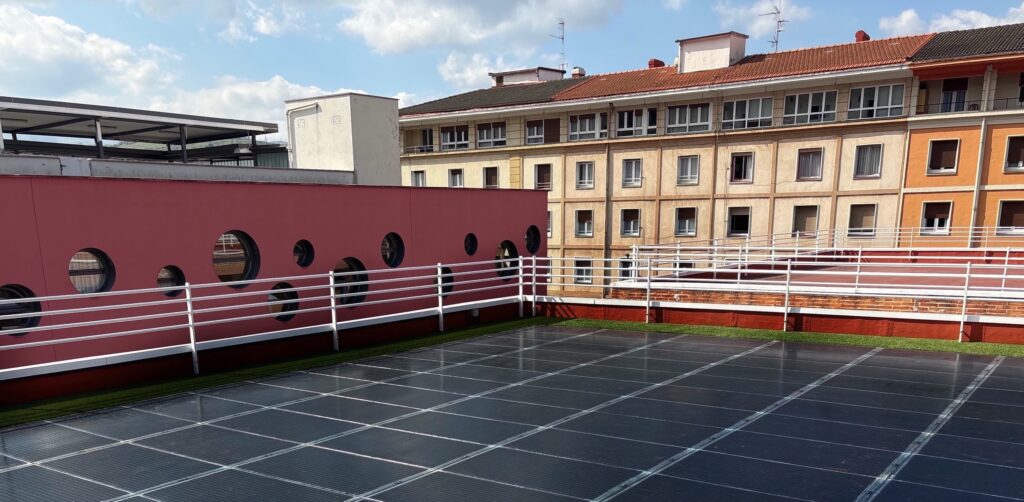
The Solum photovoltaic pavement is an innovative solution for integrating renewable energy into buildings lacking suitable roofs. This technology turns walkable surfaces into energy-generating spaces, overcoming the limitations faced when roofs are not viable for solar panel installation and still complying with SAP standards.
Main benefits of photovoltaic pavement:
- Utilization of walkable spaces: This solution allows energy generation in areas like courtyards, sidewalks, and plazas without using roofs or altering the structure.
- Regulatory compliance: Facilitates obtaining EPC “A” and BREEAM Excellent certifications by contributing to renewable generation in spaces otherwise left unused.
- Architectural integration: The modular design adapts seamlessly to urban environments without compromising aesthetic integrity.
- High energy efficiency: Optimized technology maximizes solar irradiation, ensuring efficient solar photovoltaic systems.
- Safety and low maintenance: Positioned at ground level, it minimizes risks and optimizes operational costs.
This solution is particularly beneficial in urban environments where space for traditional solar panels is limited. It is also designed to withstand pedestrian and vehicular traffic, ensuring effective integration without affecting the functionality of public or private spaces.
Achieving compliance with the standard assessment procedure through innovative solutions
Meeting UK energy efficiency standards requires the integration of renewable energy into buildings. In cases where roofs are unsuitable for solar panels, the Solum photovoltaic pavement offers a cutting-edge solution to meet the Standard Assessment Procedure (SAP). This innovative technology makes renewable generation possible in any available space, allowing buildings to maximize energy efficiency while preserving architectural and functional integrity.
By adopting such solutions and integrating renewable energy sources, buildings can meet SAP standards and reduce their environmental impact while optimizing long-term energy costs effectively.

